Religion & Morality in America by Tim Barton
December 30, 2025 | PFLN Team
Article
Share:


As we prepare to celebrate America’s 250th year, we should also anticipate opposition from those who question whether America should be celebrated. Nevertheless, the reasons to commemorate this historic milestone are substantial.
The Length of an Average Constitution in the World
- According to a study conducted by the University of Illinois along with the University of Chicago Law School, researchers sought to answer the question: “What is the average lifespan of a constitution in world history?”
- They concluded that, over the past 1,000 years, the average lifespan of a constitution is 17–19 years.
- On September 17, 2025, America celebrated 239 years under the same governing document—the Constitution.
- The United States is the longest-standing constitutional republic in the history of the world.
- Thomas Ginsburg is a Professor of Law at the University of Chicago Law School. Zachary Elkins is an Assistant Professor in the Department of Political Science at the University of Illinois. James Melton is a PhD candidate in the Department of Political Science at the University of Illinois. This article is an excerpt from their book, The Endurance of National Constitutions, published 2009 by Cambridge University Press.
- They have a separate website for all their constitution data here, which includes a portion of the book mentioned above (here) where they actually say 19 years is the life expectancy of a national constitution (see page 2 in that pdf).
(https://www.law.uchicago.edu/news/lifespan-written-constitutions)
What is the Source of American Ideals?
- Professor Donald Lutz of the University of Houston conducted a study, The Origins of American Constitutionalism (1988). He and his team conducted their research in the 1970s and 1980s to understand why the Constitution has worked so well, and where the ideas that shaped this successful document originated.
- They studied the Founding Fathers to determine the sources from which they drew their ideas. This included reviewing early state constitutions, the Founders’ letters, and any other writings they could locate in order to trace the inspiration behind America’s constitutional government.
- They specifically examined whom the Founding Fathers quoted most often in order to identify their intellectual influences. In total, they reviewed 15,000 representative writings and catalogued 3,154 quotations.
- Here are the three most frequently cited individuals:
- Charles Montesquieu: 8.3% – The most quoted individual. He authored The Spirit of the Laws (1750) and was a Christian during the Enlightenment era.
- William Blackstone: 7.9% – The second most quoted individual.
- John Locke: 2.9% – The most quoted individual specifically during the American Revolution Era.
- However, the most cited source in all the Founders’ writings was not an individual—it was the Bible, which accounted for 34% of all quotations.
- Lutz noted that they counted only quotations that appeared within quotation marks. He stated that if they had included all Biblical references—including those not placed in quotation marks—the total would have exceeded 50%.
Examples from Founding Fathers of their Reliance on the Bible
The General Principles of American are Rooted in Christian Principles
- John Adams and Thomas Jefferson ran against each other for the presidency to become the second President of the United States. In the early years of the nation, the candidate who received the most votes became President, and the runner-up became Vice President.
- Both Adams and Jefferson wrote extensively about their faith, theology, and doctrine, raising and discussing many questions. Toward the end of their lives, they exchanged numerous letters reflecting on their experiences and beliefs.
- On June 28, 1813, John Adams wrote a letter to Jefferson in which he reflected on the Revolution and stated:
“The general principles on which the fathers achieved independence were the general principles of Christianity.” (https://founders.archives.gov/documents/Jefferson/03-06-02-0208)
The Bible’s Influence on the Declaration
- Christianity’s influence on the American founding was widely accepted as a well-known fact in early American history.
- In 1928, a Duke University professor named Alice Baldwin wrote a book titled The New England Clergy and the American Revolution. In it, she observed:
“There is not a single clause in the Declaration that had not been first preached from American pulpits prior to 1763.”
- The ideas expressed in the Declaration were the same ideas the Founders had been hearing from their pastors for decades.
- The book includes appendices containing sermons that correspond to the various clauses quoted in the Declaration.
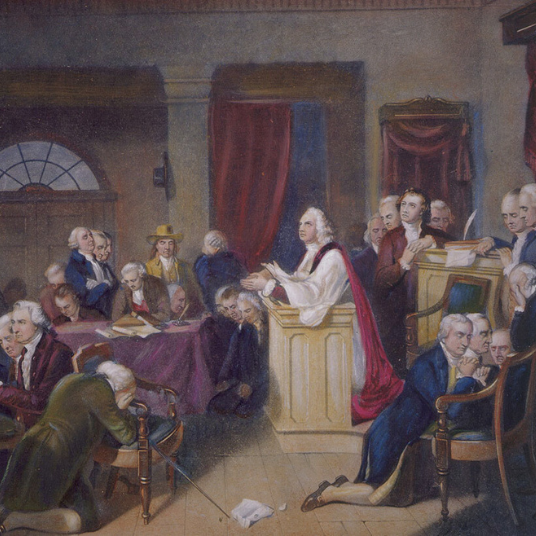
The First Time the Founding Fathers Came Together, their First Motion was to Open in Prayer
- John Adams wrote to Abigail Adams on September 16, 1774, describing their first meeting:
- “When the Congress first met, Mr. Cushing made a Motion, that it should be opened with Prayer. It was opposed by Mr. Jay of N. York and Mr. Rutledge of South Carolina, because we were so divided in religious Sentiments, some Episcopalians, some Quakers, some Anabaptists, some Presbyterians and some Congregationalists, so that We could not join in the same Act of Worship.—Mr. S. Adams arose and said he was no Bigot, and could hear a Prayer from a Gentleman of Piety and Virtue, who was at the same Time a Friend to his Country. He was a Stranger in Philadelphia, but had heard that Mr. Duchè (Dushay they pronounce it) deserved that Character, and therefore he moved that Mr. Duchè, an episcopal Clergyman, might be desired, to read Prayers to the Congress, tomorrow Morning. The Motion was seconded and passed in the Affirmative. Mr. Randolph our President, waited on Mr. Duchè, and received for Answer that if his Health would permit, he certainly would. Accordingly next Morning he appeared with his Clerk and in his Pontificallibus, and read several Prayers, in the established Form; and then read the Collect for the seventh day of September, which was the Thirty fifth Psalm.1—You must remember this was the next Morning after we heard the horrible Rumour, of the Cannonade of Boston.—I never saw a greater Effect upon an Audience. It seemed as if Heaven had ordained that Psalm to be read on that Morning.”
(https://founders.archives.gov/documents/Adams/04-01-02-0101)
- Historical records indicate that the opening, including both prayer and Scripture lessons, lasted for two hours.
- The men in that room were not chosen for their spiritual prowess; they were chosen for their political understanding and their ability to lead. These were the individuals the people trusted to guide them in the midst of political opposition.
- John Adams, after their time of prayer and Scriptures, encouraged Abigail:
- “I must beg you to read that Psalm…Read the thirty-fifth Psalm to your friends. Read it to your father.”
Continental Congress Call to Prayer
- In another letter, dated June 11, 1775, John Adams writes to Abigail about the Continental Congress’s call to prayer. Adams says:
“We have appointed a Continental fast. Millions will be upon their knees at once before their great Creator, imploring His forgiveness and blessings; His smiles on American councils and arms.”
(https://founders.archives.gov/documents/Adams/04-01-02-0146)
- This gives us an indication of what Adams believed about the American culture of his time—namely, that he expected millions to pray.
Prayer was Common in Early America
- The Continental Congress issued 15 Prayer Resolutions during the American Revolution.
- There were two types of resolutions.
- 1) Prayer and Fasting
- 2) Prayer and Thanksgiving
- There were 1,400 prayer proclamations issued in New England alone prior to 1815.
(William DeLoss Love, The Fast and Thanksgiving Days of New England (Boston: Houghton, Mifflin, and Company, 1895), 464-514, “Calendar,” https://archive.org/details/fastthanksgiving00loverich/page/464/mode/2up.)
John Adams Writes to Abigail Adams about The Events of the Revolution
- In a letter dated October 26, 1777, John Adams writes to Abigail about how the Americans defeated and destroyed a British vessel armed with 20 cannons—and another with 64 cannons.
- This was incredibly impressive for the time because America did not yet have an official navy. Great Britain was the number-one military power in the world because it possessed the world’s most formidable navy and controlled the seas.
- When America separated from Great Britain, all of the British warships remained with Britain. America had none, so the new nation began trying to build its own. What it did have were commercial shipping vessels, which the Americans armed with whatever cannons they could obtain. These improvised vessels were used to fight back against the British.
- In the Smithsonian, you can see an original gunboat from 1776—the Gunboat Philadelphia—which looks much like a rowboat outfitted with cannons.
- This is why John Adams was amazed that the Americans managed to destroy a British warship carrying 64 cannons, as well as another carrying 20 cannons.
- “Mr. Colman goes off for Boston tomorrow. I have seized a moment to congratulate you on the great and glorious success of our arms at the northward and in Delaware River. The forts at Province Island and Redbank have been defended with a magnanimity which will give our country a reputation in Europe. Colonel Greene repulsed the enemy from Redbank and took Count Donop and his aid prisoners. Colonel Smith repulsed a bold attack upon Fort Mifflin; and our galley disabled two men of men, a sixty-four and a twenty-gun ship, in such a manner that the enemy blew them up. This comes confirmed this evening, in letters from George Washington, enclosing original letters from officers in the forts. Congress will appoint a Thanksgiving, and one cause of it ought to be that the glory of turning the tide of arms is not immediately due to the Commander-in-Chief nor to southern troops. If it had been, idolatry and adulation would have been unbounded—so excessive as to endanger our liberties, for what I know. Now we can allow a certain citizen to be wise, virtuous, and good without thinking him a deity or a savior.”
(John Adams to Abigail Adams, October 26, 1777, Letters of John Adams Address to his Wife, ed. Charles Francis Adams (Boston : Charles C. Little and James Brown, 1841), II:14, https://www.google.com/books/edition/Letters_of_John_Adams_Addressed_to_His_W/yp0zAAAAMAAJ?hl=en&gbpv=1&pg=PA14&printsec=frontcover.)
John Adams Explanation for the Events of the Revolution
- John Adams wrote to Abigail Adams on December 15, 1777, saying:
- “It appears to me the eternal Son of God is operating powerfully against the British nation.”
(https://www.masshist.org/digitaladams/archive/doc?id=L17771215ja&bc=)
- You can see the full quote here:
“…One Evening, as I satt in one Room, I overheard Company of the Common sort of People in another, conversing upon serious subjects. One of them, whom I afterwards found upon Enquiry to be a reputable, religious Man, was more eloquent than the rest-he was upon the Danger of despizing and neglecting serious Things. Said whatever Person or People made light of them would soon find themselves terribly mistaken. At length I heard these Words — “it appears to me the eternal son of God is opperating Powerfully against the British Nation for their treating lightly serious Things.”
George Washington Acknowledges the Hand of Providence
- George Washington wrote to Brigadier General Thomas Nelson, Jr., August 20, 1778, and said simply:
“The hand of Providence has been so conspicuous in all this that he must be worse than an infidel that lacks faith, and more than wicked, that has not gratitude enough to acknowledge his obligations. But-it will be time enough for me to turn preacher, when my present appointment ceases; and therefore, I shall add no more on the Doctrine of Providence.”
(https://founders.archives.gov/documents/Washington/03-16-02-0373)
The Peace Treaty of Paris is Signed in 1783
- The Peace Treaty officially ending the war was signed by John Jay, John Adams and Benjamin Franklin.
- The title of this document is most significant:
It reads, “In the Name of the Most Holy and Undivided Trinity”
George Washington, America’s Most Prominent and Significant Leader, Points to Religion
- Washington says in his Farewell Address September 17, 1796:
“Of all the dispositions and habits which lead to political prosperity, religion and morality are indispensable supports. In vain would that man claim the tribute of patriotism who should labor to subvert these great pillars.”
(https://founders.archives.gov/documents/Washington/05-20-02-0440-0002)
- Out of everything he said in his Farewell Address, the only things he identified that that were indispensable were religion and morality.
John Adam’s Letter to the Massachusetts Militia
- In a letter dated October 11, 1798, John Adams wrote in part:
“Our Constitution was made only for a moral and religious People. It is wholly inadequate to the government of any other”
(https://founders.archives.gov/documents/Adams/99-02-02-3102)
- Our Constitution is built on the premise of granting freedom to the people. But freedom only works when it rests on a moral foundation.
- The Founders believed that “religion” was Christianity and that “morality” came from the Bible, because that was the source from which people learned right and wrong. They warned that without Christianity and the Bible, America would not succeed.
Historian Stephen Colwell from the 1800’s Affirmed the Founders Belief in Christianity
- Colwell said of the Constitutional Convention:
“It was in the very spirit of true Christianity that the hospitality and blessings of the United States were offered to all the world; all were invited to enjoy and not to subvert. The Christian men of that day…intended that the nation should continue to be a Christian nation…They did not place Christianity beneath nor over their political institutions: it was rather to be the atmosphere which they breathed who administered them. It was to be the source of their inspiration who sought to make them [the blessings] available for human advantage. These institutions and laws were to be the instruments of Christian men for the good of the whole human family.”
(Stephen Colwell, The Position of Christianity in the United States In Its Relations With Our Political Institutions (Philadelphia: Lippincott, Grambo & Co., 1854), 12-13, https://www.google.com/books/edition/The_Position_of_Christianity_in_the_Unit/MX-fdBufxhAC?hl=en&gbpv=1&pg=PA12&printsec=frontcover.)
- He said Christianity was the atmosphere the Founding Fathers breathed.
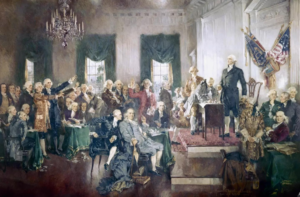
Howard Chandler Christy’s Painting from 1940
- It is one of the most famous paintings of the Constitutional Convention. Measuring 20 feet tall and 30 feet long, it hangs in the U.S. Capitol Building. On the 137th anniversary of the U.S. Constitution, Congress commissioned a painter to create a depiction of the historic event.
- Howard Chandler Christy, a noted painter of the time, was chosen for the task. Christy said he wanted to study the Founding Fathers before creating the painting, where he learned how highly they valued the Bible. He researched whether the Founders had any lists of books or resources present in the room as they wrote the Constitution.
- Christy concluded that people who valued the Bible as much as the Founders did—and quoted it as frequently—most likely had a Bible in the room. Therefore, he included a Bible in the painting, in the bottom right-hand corner. The Bible is open to Matthew 5, depicting the Sermon on the Mount.
(https://lawliberty.org/the-conventions-story-on-canvas/)
Conclusion
God should always be part of what He created. He established three primary institutions: 1) Family, 2) Church, and 3) Government. Christians should recognize God’s essential and necessary involvement in all three.
We would never say that God should be excluded from the family or the church, yet too often Christians have wrongly assumed that God should be pushed aside in government.
What about those in society who argue that we should not “legislate morality”? Put simply, every piece of legislation regulates morality. The question is not whether we legislate morality—it is whose morality will guide our laws. If people suggest that we should not legislate morality according to the greatest standard ever given—the teachings of Jesus—then whose standards will we use? Either we rely on an objective standard based on the Bible, or we depend on human reasoning, which is ever-shifting and inconsistent.
There are countless examples from early America that illustrate this simple point: God’s ways work, and those who walk according to the Lord are blessed. All of the early colonies were founded in a covenantal fashion. While not all fully followed the covenant, their formation reflected a recognition of God’s authority and guidance.
John Winthrop’s Sermon Before they Depart for America
- Winthrop’s Sermon, “A Model of Christian Charity” says in part:
“For we must consider that we shall be as a city upon a hill. The eyes of all people are upon us. So that if we shall deal falsely with our God in this work we have undertaken, and so cause him to withdraw his present help from us, we shall be made a story and a by-word through the world.”
(https://teachingamericanhistory.org/document/a-model-of-christian-charity-2/)(https://www.masshist.org/publications/winthrop/index.php/view/PWF02d270)
President John Quincy Adams Links the Birth of the Nation to the Birth of the Savior
- John Quincy Adams, the son of John Adams, served as a diplomat to Paris at the age of 10 and to Russia by the age of 14.
- On the 63rd anniversary of the Declaration of Independence, he delivered an anniversary speech in which he posed several rhetorical questions:
- “Why is it that, next to the birthday of the Savior of the World, your most joyous and most venerated festival returns on this day? … Is it not that, in the chain of human events, the birthday of the nation is indissolubly linked with the birthday of the Savior? That it forms a leading event in the progress of the gospel dispensation?”
- “Is it not that the Declaration of Independence first organized the social compact on the foundation of the Redeemer’s mission upon earth? That it laid the corner stone of human government upon the first precepts of Christianity…”
(An Oration Delivered Before the Inhabitants of the Town of Newburyport, at their request, on the Sixty-First Anniversary of the Declaration of Independence, July 4th, 1837. https://wallbuilders.com/resource/oration-july-4th-1837/)
- None of the Founding Fathers believed they were creating a secular government. They all understood that they were establishing a government grounded in Christian principles.
Benjamin Franklin, Considered One of the “Least” Religious Founding Fathers, Believed in Prayer
- It was Benjamin Franklin who called for prayer during the Constitutional Convention.
On June 28, 1787, Franklin said in his speech:- “In this situation of this Assembly, groping, as it were, in the dark to find political truth, and scarce able to distinguish it when presented to us, how has it happened, sir, that we have not hitherto once thought of humbly applying to the Father of Lights, to illuminate our understanding?”
- “In the beginning of the contest with Great Britain, when we were sensible of danger, we had daily prayer in this room for Divine protection. Our prayers were heard, and they were graciously answered.”
- “All of us engaged in the struggle must have observed frequent instances of a superintending Providence in our favor. And have we now forgotten this powerful Friend? Or do we imagine we no longer need His assistance?”
- “I have lived, Sir, a long time, and the longer I live, the more convincing proofs I see of this truth – that God governs the affairs of men.”
- “If a sparrow cannot fall to the ground without His notice, is it probable that an empire can rise without His aid? We have been assured in the Sacred Writings that ‘except the Lord build the house, they labor in vain that build it.”
- “I firmly believe this; and I also believe without His concurring aid we shall succeed in this political building no better than the builders of Babel, and we shall become a reproach and a byword down to future ages.”
- “I therefore beg leave to move that, henceforth, prayers imploring the assistance of Heaven and its blessing on our deliberation be held in this assembly every morning before we proceed to business.”
(https://wallbuilders.com/resource/franklins-appeal-for-prayer-at-the-constitutional-convention/)
Scripture reminds us in Psalm 127:1, “Unless the Lord builds the house, they labor in vain who build it.” In everything we do, the Lord must be part of it. Proverbs 14:34 says, “Righteousness exalts a nation…” If we want to make America great again, we must restore the foundation that made her great in the first place.
Here is what makes a nation great: doing it God’s way. Everything we do should be rooted in Scripture. Nehemiah 2:17 says, “Come, let us rebuild…that we will no longer be a disgrace.” Our call is to rebuild—regardless of what others may say—rolling up our sleeves, placing one stone at a time, and faithfully restoring what has been broken.
If you are a lawmaker who would like assistance with legislation in your state, please don’t hesitate to contact us. We would love to serve you.
If you would like to donate to our mission at PFLN to help lawmakers advance religious freedom and constitutional policies, we greatly value your support! You can make a tax-deductible donation here.