Carbon Capture and Storage Projects: The Threat to Property Rights

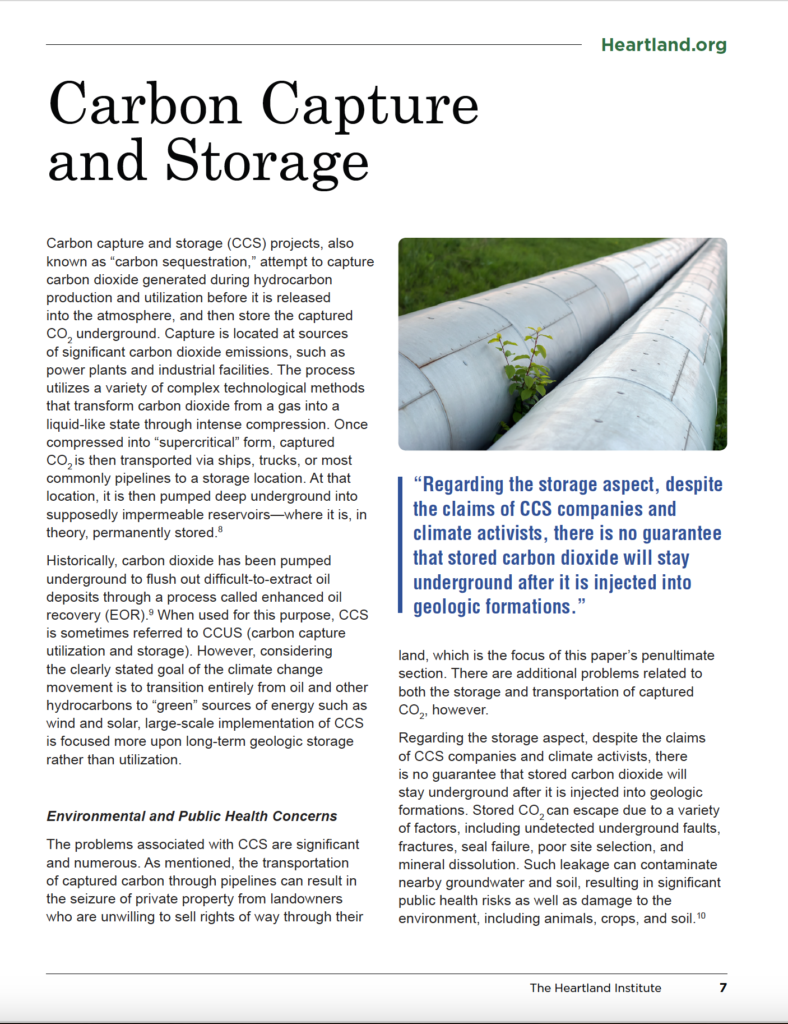
Carbon capture and storage (CCS) is one of the latest methods climate activists are using to combat greenhouse gases and achieve “net-zero” carbon dioxide emissions. Government-funded CCS companies manage projects that capture CO2 emissions at their source and condense carbon dioxide into a liquid-like “supercritical” state. The liquified CO2 is then transported through pipelines or other means to storage sites, where it is pumped deep underground in to geologic formations. The process creates an array of problems, with one of the largest being the abrogation of private property rights—one of the most fundamental pillars the United States was founded upon.

Read the rest of the Policy Tip Sheet here.

Reach out to us here if you would like assistance with legislation in your state.
Carbon Capture & Property Rights

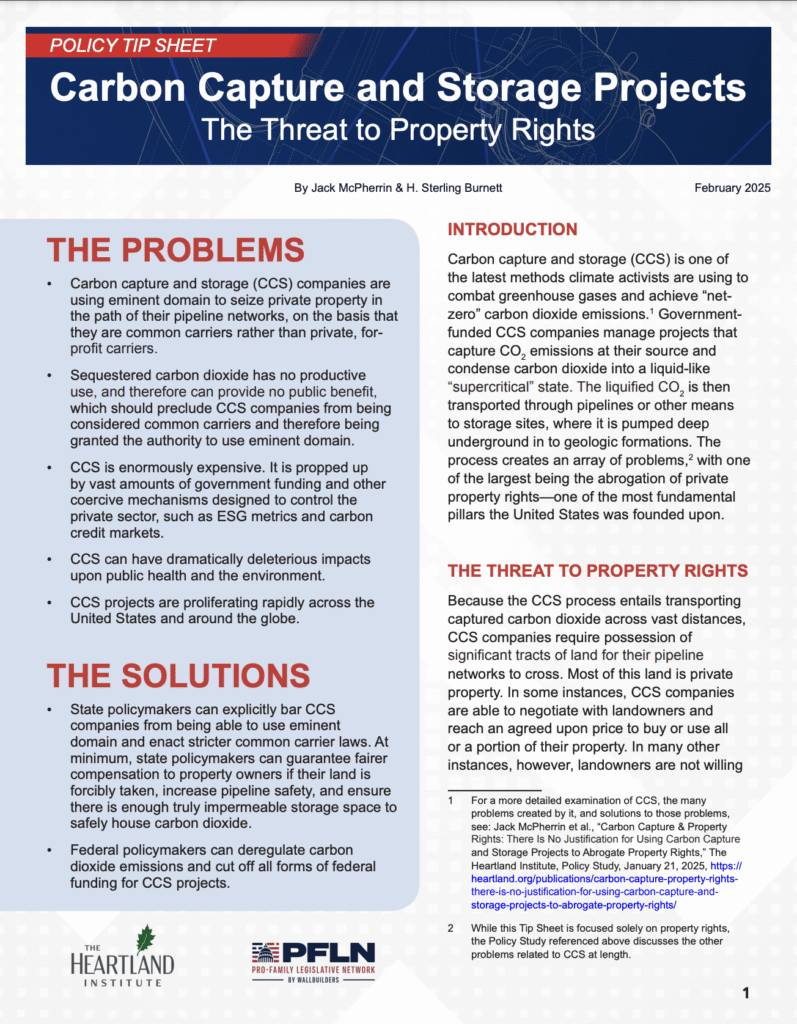
The Heartland Institute 5 Carbon capture and storage (CCS) projects have become an increasingly popular method by which climate activists pursue their ultimate goal of global “net-zero” carbon dioxide (CO2) emissions. Rather than focusing upon the societal harms of climate alarmism in general, this paper will focus specifically on the harms inflicted by CCS, with a particular emphasis upon the revocation of private property rights through the use of eminent domain.

This paper begins with a brief background of the chain of events and overarching agenda that has spawned CCS and an explanation of the CCS process. It then covers the significant public health and environmental problems that can be the direct result of CCS projects, as well as the massive public-private partnerships and funding mechanisms that incentivize the proliferation of CCS. The paper will close by clarifying how CCS indeed poses an imminent threat to Americans’ fundamental private property rights and providing specific recommendations for policymakers to protect those rights and push back against the green agenda.

Read the rest of the paper here.

Reach out to us here if you would like assistance with legislation in your state.