Religion & Morality in America by Tim Barton

As we prepare to celebrate America’s 250th year, we should also anticipate opposition from those who question whether America should be celebrated. Nevertheless, the reasons to commemorate this historic milestone are substantial.


The Length of an Average Constitution in the World

  • According to a study conducted by the University of Illinois along with the University of Chicago Law School, researchers sought to answer the question: “What is the average lifespan of a constitution in world history?”
  • They concluded that, over the past 1,000 years, the average lifespan of a constitution is 17–19 years.
  • On September 17, 2025, America celebrated 239 years under the same governing document—the Constitution.
  • The United States is the longest-standing constitutional republic in the history of the world.
    • Thomas Ginsburg is a Professor of Law at the University of Chicago Law School. Zachary Elkins is an Assistant Professor in the Department of Political Science at the University of Illinois. James Melton is a PhD candidate in the Department of Political Science at the University of Illinois. This article is an excerpt from their book, The Endurance of National Constitutions, published 2009 by Cambridge University Press.
    • They have a separate website for all their constitution data here, which includes a portion of the book mentioned above (here) where they actually say 19 years is the life expectancy of a national constitution (see page 2 in that pdf).

(https://www.law.uchicago.edu/news/lifespan-written-constitutions)


What is the Source of American Ideals?

  • Professor Donald Lutz of the University of Houston conducted a study, The Origins of American Constitutionalism (1988). He and his team conducted their research in the 1970s and 1980s to understand why the Constitution has worked so well, and where the ideas that shaped this successful document originated.
  • They studied the Founding Fathers to determine the sources from which they drew their ideas. This included reviewing early state constitutions, the Founders’ letters, and any other writings they could locate in order to trace the inspiration behind America’s constitutional government.
  • They specifically examined whom the Founding Fathers quoted most often in order to identify their intellectual influences. In total, they reviewed 15,000 representative writings and catalogued 3,154 quotations.
  • Here are the three most frequently cited individuals:
    • Charles Montesquieu: 8.3% – The most quoted individual. He authored The Spirit of the Laws (1750) and was a Christian during the Enlightenment era.
    • William Blackstone: 7.9% – The second most quoted individual.
    • John Locke: 2.9% – The most quoted individual specifically during the American Revolution Era.
  • However, the most cited source in all the Founders’ writings was not an individual—it was the Bible, which accounted for 34% of all quotations.
  • Lutz noted that they counted only quotations that appeared within quotation marks. He stated that if they had included all Biblical references—including those not placed in quotation marks—the total would have exceeded 50%.


Examples from Founding Fathers of their Reliance on the Bible

The General Principles of American are Rooted in Christian Principles

  • John Adams and Thomas Jefferson ran against each other for the presidency to become the second President of the United States. In the early years of the nation, the candidate who received the most votes became President, and the runner-up became Vice President.
  • Both Adams and Jefferson wrote extensively about their faith, theology, and doctrine, raising and discussing many questions. Toward the end of their lives, they exchanged numerous letters reflecting on their experiences and beliefs.
  • On June 28, 1813, John Adams wrote a letter to Jefferson in which he reflected on the Revolution and stated:

“The general principles on which the fathers achieved independence were the general principles of Christianity.” (https://founders.archives.gov/documents/Jefferson/03-06-02-0208)


The Bible’s Influence on the Declaration

  • Christianity’s influence on the American founding was widely accepted as a well-known fact in early American history.
  • In 1928, a Duke University professor named Alice Baldwin wrote a book titled The New England Clergy and the American Revolution. In it, she observed:

“There is not a single clause in the Declaration that had not been first preached from American pulpits prior to 1763.”

  • The ideas expressed in the Declaration were the same ideas the Founders had been hearing from their pastors for decades.
  • The book includes appendices containing sermons that correspond to the various clauses quoted in the Declaration.


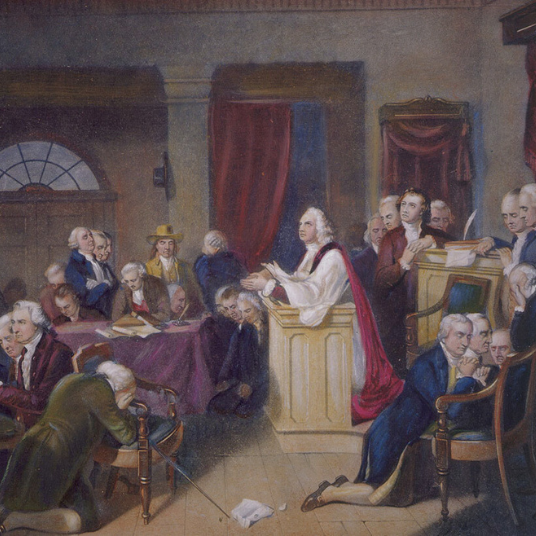
The First Time the Founding Fathers Came Together, their First Motion was to Open in Prayer

  • John Adams wrote to Abigail Adams on September 16, 1774, describing their first meeting:
    • “When the Congress first met, Mr. Cushing made a Motion, that it should be opened with Prayer. It was opposed by Mr. Jay of N. York and Mr. Rutledge of South Carolina, because we were so divided in religious Sentiments, some Episcopalians, some Quakers, some Anabaptists, some Presbyterians and some Congregationalists, so that We could not join in the same Act of Worship.—Mr. S. Adams arose and said he was no Bigot, and could hear a Prayer from a Gentleman of Piety and Virtue, who was at the same Time a Friend to his Country. He was a Stranger in Philadelphia, but had heard that Mr. Duchè (Dushay they pronounce it) deserved that Character, and therefore he moved that Mr. Duchè, an episcopal Clergyman, might be desired, to read Prayers to the Congress, tomorrow Morning. The Motion was seconded and passed in the Affirmative. Mr. Randolph our President, waited on Mr. Duchè, and received for Answer that if his Health would permit, he certainly would. Accordingly next Morning he appeared with his Clerk and in his Pontificallibus, and read several Prayers, in the established Form; and then read the Collect for the seventh day of September, which was the Thirty fifth Psalm.1—You must remember this was the next Morning after we heard the horrible Rumour, of the Cannonade of Boston.—I never saw a greater Effect upon an Audience. It seemed as if Heaven had ordained that Psalm to be read on that Morning.”

(https://founders.archives.gov/documents/Adams/04-01-02-0101)

  • Historical records indicate that the opening, including both prayer and Scripture lessons, lasted for two hours.
  • The men in that room were not chosen for their spiritual prowess; they were chosen for their political understanding and their ability to lead. These were the individuals the people trusted to guide them in the midst of political opposition.
  • John Adams, after their time of prayer and Scriptures, encouraged Abigail:
    • “I must beg you to read that Psalm…Read the thirty-fifth Psalm to your friends. Read it to your father.”


Continental Congress Call to Prayer

  • In another letter, dated June 11, 1775, John Adams writes to Abigail about the Continental Congress’s call to prayer. Adams says:

“We have appointed a Continental fast. Millions will be upon their knees at once before their great Creator, imploring His forgiveness and blessings; His smiles on American councils and arms.”

(https://founders.archives.gov/documents/Adams/04-01-02-0146)

  • This gives us an indication of what Adams believed about the American culture of his time—namely, that he expected millions to pray.


Prayer was Common in Early America

  • The Continental Congress issued 15 Prayer Resolutions during the American Revolution.
    • There were two types of resolutions.
    • 1) Prayer and Fasting
    • 2) Prayer and Thanksgiving
  • There were 1,400 prayer proclamations issued in New England alone prior to 1815.

(William DeLoss Love, The Fast and Thanksgiving Days of New England (Boston: Houghton, Mifflin, and Company, 1895), 464-514, “Calendar,” https://archive.org/details/fastthanksgiving00loverich/page/464/mode/2up.)


John Adams Writes to Abigail Adams about The Events of the Revolution

  • In a letter dated October 26, 1777, John Adams writes to Abigail about how the Americans defeated and destroyed a British vessel armed with 20 cannons—and another with 64 cannons.
  • This was incredibly impressive for the time because America did not yet have an official navy. Great Britain was the number-one military power in the world because it possessed the world’s most formidable navy and controlled the seas.
  • When America separated from Great Britain, all of the British warships remained with Britain. America had none, so the new nation began trying to build its own. What it did have were commercial shipping vessels, which the Americans armed with whatever cannons they could obtain. These improvised vessels were used to fight back against the British.
  • In the Smithsonian, you can see an original gunboat from 1776—the Gunboat Philadelphia—which looks much like a rowboat outfitted with cannons.
  • This is why John Adams was amazed that the Americans managed to destroy a British warship carrying 64 cannons, as well as another carrying 20 cannons.
    • “Mr. Colman goes off for Boston tomorrow. I have seized a moment to congratulate you on the great and glorious success of our arms at the northward and in Delaware River. The forts at Province Island and Redbank have been defended with a magnanimity which will give our country a reputation in Europe. Colonel Greene repulsed the enemy from Redbank and took Count Donop and his aid prisoners. Colonel Smith repulsed a bold attack upon Fort Mifflin; and our galley disabled two men of men, a sixty-four and a twenty-gun ship, in such a manner that the enemy blew them up. This comes confirmed this evening, in letters from George Washington, enclosing original letters from officers in the forts. Congress will appoint a Thanksgiving, and one cause of it ought to be that the glory of turning the tide of arms is not immediately due to the Commander-in-Chief nor to southern troops. If it had been, idolatry and adulation would have been unbounded—so excessive as to endanger our liberties, for what I know. Now we can allow a certain citizen to be wise, virtuous, and good without thinking him a deity or a savior.”

(John Adams to Abigail Adams, October 26, 1777, Letters of John Adams Address to his Wife, ed. Charles Francis Adams (Boston : Charles C. Little and James Brown, 1841), II:14, https://www.google.com/books/edition/Letters_of_John_Adams_Addressed_to_His_W/yp0zAAAAMAAJ?hl=en&gbpv=1&pg=PA14&printsec=frontcover.)


John Adams Explanation for the Events of the Revolution

  • John Adams wrote to Abigail Adams on December 15, 1777, saying:
    • “It appears to me the eternal Son of God is operating powerfully against the British nation.”

(https://www.masshist.org/digitaladams/archive/doc?id=L17771215ja&bc=)

  • You can see the full quote here:

“…One Evening, as I satt in one Room, I overheard Company of the Common sort of People in another, conversing upon serious subjects. One of them, whom I afterwards found upon Enquiry to be a reputable, religious Man, was more eloquent than the rest-he was upon the Danger of despizing and neglecting serious Things. Said whatever Person or People made light of them would soon find themselves terribly mistaken. At length I heard these Words — “it appears to me the eternal son of God is opperating Powerfully against the British Nation for their treating lightly serious Things.”


George Washington Acknowledges the Hand of Providence

  • George Washington wrote to Brigadier General Thomas Nelson, Jr., August 20, 1778, and said simply:

“The hand of Providence has been so conspicuous in all this that he must be worse than an infidel that lacks faith, and more than wicked, that has not gratitude enough to acknowledge his obligations. But-it will be time enough for me to turn preacher, when my present appointment ceases; and therefore, I shall add no more on the Doctrine of Providence.”

(https://founders.archives.gov/documents/Washington/03-16-02-0373)


The Peace Treaty of Paris is Signed in 1783

  • The Peace Treaty officially ending the war was signed by John Jay, John Adams and Benjamin Franklin.
  • The title of this document is most significant:

It reads, “In the Name of the Most Holy and Undivided Trinity”


George Washington, America’s Most Prominent and Significant Leader, Points to Religion

  • Washington says in his Farewell Address September 17, 1796:

“Of all the dispositions and habits which lead to political prosperity, religion and morality are indispensable supports. In vain would that man claim the tribute of patriotism who should labor to subvert these great pillars.”

(https://founders.archives.gov/documents/Washington/05-20-02-0440-0002)

  • Out of everything he said in his Farewell Address, the only things he identified that that were indispensable were religion and morality.


John Adam’s Letter to the Massachusetts Militia

  • In a letter dated October 11, 1798, John Adams wrote in part:

“Our Constitution was made only for a moral and religious People. It is wholly inadequate to the government of any other”

(https://founders.archives.gov/documents/Adams/99-02-02-3102)

  • Our Constitution is built on the premise of granting freedom to the people. But freedom only works when it rests on a moral foundation.
  • The Founders believed that “religion” was Christianity and that “morality” came from the Bible, because that was the source from which people learned right and wrong. They warned that without Christianity and the Bible, America would not succeed.


Historian Stephen Colwell from the 1800’s Affirmed the Founders Belief in Christianity

  • Colwell said of the Constitutional Convention:

“It was in the very spirit of true Christianity that the hospitality and blessings of the United States were offered to all the world; all were invited to enjoy and not to subvert. The Christian men of that day…intended that the nation should continue to be a Christian nation…They did not place Christianity beneath nor over their political institutions: it was rather to be the atmosphere which they breathed who administered them. It was to be the source of their inspiration who sought to make them [the blessings] available for human advantage. These institutions and laws were to be the instruments of Christian men for the good of the whole human family.”

(Stephen Colwell, The Position of Christianity in the United States In Its Relations With Our Political Institutions (Philadelphia: Lippincott, Grambo & Co., 1854), 12-13, https://www.google.com/books/edition/The_Position_of_Christianity_in_the_Unit/MX-fdBufxhAC?hl=en&gbpv=1&pg=PA12&printsec=frontcover.)

  • He said Christianity was the atmosphere the Founding Fathers breathed.


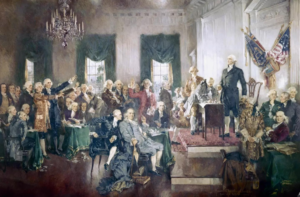
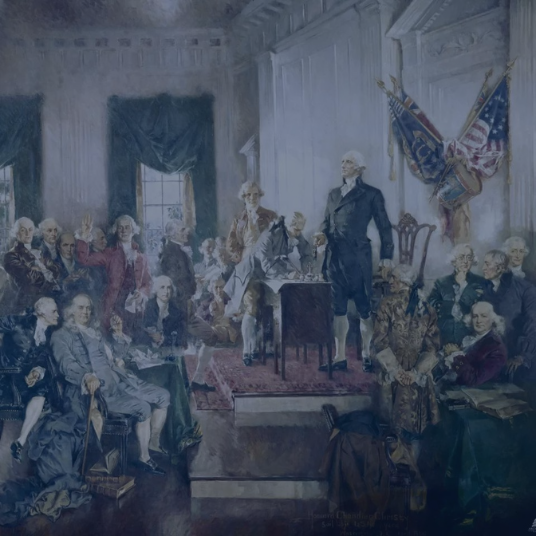
Howard Chandler Christy’s Painting from 1940

  • It is one of the most famous paintings of the Constitutional Convention. Measuring 20 feet tall and 30 feet long, it hangs in the U.S. Capitol Building. On the 137th anniversary of the U.S. Constitution, Congress commissioned a painter to create a depiction of the historic event.
  • Howard Chandler Christy, a noted painter of the time, was chosen for the task. Christy said he wanted to study the Founding Fathers before creating the painting, where he learned how highly they valued the Bible. He researched whether the Founders had any lists of books or resources present in the room as they wrote the Constitution.
  • Christy concluded that people who valued the Bible as much as the Founders did—and quoted it as frequently—most likely had a Bible in the room. Therefore, he included a Bible in the painting, in the bottom right-hand corner. The Bible is open to Matthew 5, depicting the Sermon on the Mount.

(https://lawliberty.org/the-conventions-story-on-canvas/)
Conclusion

God should always be part of what He created. He established three primary institutions: 1) Family, 2) Church, and 3) Government. Christians should recognize God’s essential and necessary involvement in all three.


We would never say that God should be excluded from the family or the church, yet too often Christians have wrongly assumed that God should be pushed aside in government.


What about those in society who argue that we should not “legislate morality”? Put simply, every piece of legislation regulates morality. The question is not whether we legislate morality—it is whose morality will guide our laws. If people suggest that we should not legislate morality according to the greatest standard ever given—the teachings of Jesus—then whose standards will we use? Either we rely on an objective standard based on the Bible, or we depend on human reasoning, which is ever-shifting and inconsistent.


There are countless examples from early America that illustrate this simple point: God’s ways work, and those who walk according to the Lord are blessed. All of the early colonies were founded in a covenantal fashion. While not all fully followed the covenant, their formation reflected a recognition of God’s authority and guidance.


John Winthrop’s Sermon Before they Depart for America

  • Winthrop’s Sermon, “A Model of Christian Charity” says in part:

“For we must consider that we shall be as a city upon a hill. The eyes of all people are upon us. So that if we shall deal falsely with our God in this work we have undertaken, and so cause him to withdraw his present help from us, we shall be made a story and a by-word through the world.”

(https://teachingamericanhistory.org/document/a-model-of-christian-charity-2/)(https://www.masshist.org/publications/winthrop/index.php/view/PWF02d270)


President John Quincy Adams Links the Birth of the Nation to the Birth of the Savior

  • John Quincy Adams, the son of John Adams, served as a diplomat to Paris at the age of 10 and to Russia by the age of 14.
  • On the 63rd anniversary of the Declaration of Independence, he delivered an anniversary speech in which he posed several rhetorical questions:
    • “Why is it that, next to the birthday of the Savior of the World, your most joyous and most venerated festival returns on this day? … Is it not that, in the chain of human events, the birthday of the nation is indissolubly linked with the birthday of the Savior? That it forms a leading event in the progress of the gospel dispensation?”
    • “Is it not that the Declaration of Independence first organized the social compact on the foundation of the Redeemer’s mission upon earth? That it laid the corner stone of human government upon the first precepts of Christianity…”

(An Oration Delivered Before the Inhabitants of the Town of Newburyport, at their request, on the Sixty-First Anniversary of the Declaration of Independence, July 4th, 1837. https://wallbuilders.com/resource/oration-july-4th-1837/)

  • None of the Founding Fathers believed they were creating a secular government. They all understood that they were establishing a government grounded in Christian principles.


Benjamin Franklin, Considered One of the “Least” Religious Founding Fathers, Believed in Prayer

  • It was Benjamin Franklin who called for prayer during the Constitutional Convention.
    On June 28, 1787, Franklin said in his speech:

    • “In this situation of this Assembly, groping, as it were, in the dark to find political truth, and scarce able to distinguish it when presented to us, how has it happened, sir, that we have not hitherto once thought of humbly applying to the Father of Lights, to illuminate our understanding?”
    • “In the beginning of the contest with Great Britain, when we were sensible of danger, we had daily prayer in this room for Divine protection. Our prayers were heard, and they were graciously answered.”
    • “All of us engaged in the struggle must have observed frequent instances of a superintending Providence in our favor. And have we now forgotten this powerful Friend? Or do we imagine we no longer need His assistance?”
    • “I have lived, Sir, a long time, and the longer I live, the more convincing proofs I see of this truth – that God governs the affairs of men.”
    • “If a sparrow cannot fall to the ground without His notice, is it probable that an empire can rise without His aid? We have been assured in the Sacred Writings that ‘except the Lord build the house, they labor in vain that build it.”
    • “I firmly believe this; and I also believe without His concurring aid we shall succeed in this political building no better than the builders of Babel, and we shall become a reproach and a byword down to future ages.”
    • “I therefore beg leave to move that, henceforth, prayers imploring the assistance of Heaven and its blessing on our deliberation be held in this assembly every morning before we proceed to business.”

(https://wallbuilders.com/resource/franklins-appeal-for-prayer-at-the-constitutional-convention/)


Scripture reminds us in Psalm 127:1, “Unless the Lord builds the house, they labor in vain who build it.” In everything we do, the Lord must be part of it. Proverbs 14:34 says, “Righteousness exalts a nation…” If we want to make America great again, we must restore the foundation that made her great in the first place.


Here is what makes a nation great: doing it God’s way. Everything we do should be rooted in Scripture. Nehemiah 2:17 says, “Come, let us rebuild…that we will no longer be a disgrace.” Our call is to rebuild—regardless of what others may say—rolling up our sleeves, placing one stone at a time, and faithfully restoring what has been broken.

If you are a lawmaker who would like assistance with legislation in your state, please don’t hesitate to contact us. We would love to serve you. 

If you would like to donate to our mission at PFLN to help lawmakers advance religious freedom and constitutional policies, we greatly value your support! You can make a tax-deductible donation here. 
Life, Liberty and Property by Tim Barton

Access this resource in an easy to print PDF here.

A Biblical and Historic Understanding of Private Property

It’s important to understand what the Bible says about private property. It’s also worth noting that the Founding Fathers drew heavily from Scripture in forming their beliefs as they established America.

Biblical Perspective

The foundation of Christian beliefs about private property begins with the understanding that we are all stewards of what God has given us. God created the heavens and the earth. Only after He made the heavens and the earth did God create humanity—male and female—and bless them, commanding them to “fill the earth and subdue it.”

  • Psalm 24:1 – “The earth is the Lord’s and all its fullness, The world and those who dwell therein.”
  • Genesis 1:1 – “In the beginning God created the heavens and the earth.”
  • Genesis 1:27-28 – “So God created man in His own image; in the image of God he created him; male and female he created them. Then God blessed them, and God said to them, ‘Be fruitful and multiply; fill the earth and subdue it.”
  • Genesis 2:15 – “Then the Lord God took the man and put him in the garden of Eden to tend and keep it.”


The Abrahamic Covenant

  • Genesis 12:1-3 – The Lord said to Abram…I will give you a land…‘I will make you into a great nation…’”
  • When the Israelites were enslaved, God did incredible miracles to free them and lead them to Mount Sinai, where He gives them the Ten Commandments.


The Ten Commandments

  • Two of the Ten Commandments deal with private property.

1.) Thou Shall Not Steal

2.) Though Shall Not Covet

  • The Bible says you do not take someone else’s stuff, and you don’t even dream of taking someone else’s stuff.


Samuel Warns Israel that Kings will Take their Property

  • 1 Samuel 8 the Israelites ask for a King and Samuel warns the people of Israel of the dangers of having a king, and one of the things he warns them about is that a king will take their property.
    • 1 Samuel 8:10-18 – “So Samuel told all the words of the Lord to the people who asked him for a king. And he said, ‘This will be the behavior of the king who will reign over you: He will take your sons and appoint them for his own chariots and to be his horsemen, and some will run before his chariots. He will appoint captains over his thousands and captains over his fifties, will set some to plow his ground and reap his harvest, and some to make his weapons of war and equipment for his chariots. He will take your daughters to be perfumers, cooks, and bakers. And he will take the best of your fields, your vineyards, and your olive groves, and give them to his servants. He will take a tenth of your grain and your vintage, and give it to his officers and servants. And he will take your male servants, your female servants, your finest [a]young men, and your donkeys, and put them to his work. He will take a tenth of your sheep. And you will be his servants. And you will cry out in that day because of your king whom you have chosen for yourselves, and the Lord will not hear you in that day.’”


Attacks on Private Property

  • Whatever the Bible says, the devil’s game plan is exactly what God says—but in reverse.
  • Throughout history, we see attacks on private property.
  • Karl Marx in his Communist Manifesto said, “The theory of the Communists may be summed up in a single sentence: the abolition of private property.”
    • (Karl Marx, Manifesto of the Communist Party, trans. Frederick Engels (1969, original 1848), 22.)
  • In the 2030 Agenda from the World Health Organization they have a line that states simply, “You will own nothing, and you will be happy.”
    • This originates from a 2016 essay by Danish politician Ida Auken, titled “Welcome to 2030. I own nothing, have no privacy, and life has never been better.” The piece was published as part of the World Economic Forum (WEF)’s series on future scenarios.


The Founders Perspective on Private Property

  • The Founding Fathers were students of the Bible.


John Locke

  • He was the individual most quoted by the Founding Fathers during the American Revolution.
  • In his Two Treaties of Government, Locke writes that God has not given kings authority over the land.
    • John Locke says in Chapter V: Of Property, and again in Chapter IX: Of the Ends of Political Society and Government (Section 124): “The great and chief end, therefore, of men’s uniting into commonwealths, and putting themselves under government, is the preservation of their property.”
  • In Chapter II: Of the State of Nature (Ch II, Section 6), Locke further expounds on private property.
    • Locke writes, “The state of nature has a law of nature to govern it, which obliges everyone: and reason, which is that law, teaches all mankind who will but consult it, that being all equal and independent, no one ought to harm another in his life, health, liberty, or possessions.”


Samuel Adams

  • Leader of the Sons of Liberty and known as the Father of the Revolution.
    • He wrote the first ever publication from the Committee of Correspondence where he says, “Among the natural rights of the Colonists are these: First, a right to life; Secondly, to liberty; Thirdly, to property; together with the right to support and defend them in the best manner they can.”

(“The Rights Of The Colonists, A List of Violations Of Rights and A Letter Of Correspondence, Adopted by the Town of Boston, November 20, 1772,” The Life and Public Service of Samuel Adams, ed. William V. Wells (Boston: Little, Brown and Company, 1865), I:502.)


The Declaration of Independence

  • Thomas Jefferson wrote in the Declaration of Independence:
    • “We hold these truths to be self-evident, that all men are created equal, that they are endowed by their Creator with certain unalienable rights, that among these are life, liberty and the pursuit of happiness. That to secure these rights, governments are instituted among men, deriving their just powers from the consent of the governed.”
  • Some may wonder why he wrote “happiness instead of property.”
  • The Virginia Declaration of Rights (written June, 1776) was very influential on Jefferson.
    • The author of this was George Mason, known as the Father of the Bill of Rights. And he had two reasons why he didn’t sign the Constitution.
      • ) It didn’t have a bill of rights.
      • ) It didn’t end slavery.
    • Section 1 of the Virginia Declaration of Rights states: “That all men are by nature equally free and independent and have certain inherent rights, of which, when they enter into a state of society, they cannot, by any compact, deprive or divest their posterity; namely, the enjoyment of life and liberty, with the means of acquiring and possessing property, and pursuing and obtaining happiness and safety.”

(The Federal and State Constitutions, Colonial Charters, and Other Organic Laws, ed. Francis Newton Thrope (Washington: Government Printing Office, 1909), VII:3813.)

  • This document comes out the month before the Declaration.
  • Some people tried to advocate that owning slaves was considered their “property” which is likely why they didn’t use the word “property” in the Declaration.


John Dickinson

  • Dickinson was known as the Penman of the Revolution and wrote 12 “Letters from a Farmer in Pennsylvania.” (He was also a member of the Continental Congress, Governor of Pennsylvania and Delaware and Signer of the U.S. Constitution.)
  • One of the early essays he wrote stated,
    • “Let these truths be indelibly impressed on our minds—-that we cannot be happy without being free—that we cannot be free without being secure in our property—that we cannot be secure in our property if without our consent others may as by right take it away.

(John Dickinson, “Letters from a Farmer: Letter XII,” 1767, The Political Writings of John Dickinson (Wilmington: Bonsal and Niles, 1801), I:275.)


John Adams

  • In 1787, John Adams wrote a work titled ADefense of the Constitution of the Government of the United States of America, and in it he said,
    • “Property is surely a right of mankind as really as liberty.”
  • Jefferson agreed, echoing:
    • “The moment the idea is admitted into society, that property is not as sacred as the laws of God and that there is not a source of law and public justice to protect it, anarchy and tyranny commence. If “Thou shalt not covet,” and “Thou shalt not steal,” were not commandments of Heaven, they must be made inviolable precepts in every society, before it can be civilized or made free.”

(John Adams, The Works of John Adams, ed. Charles Francis Adams (Boston: Charles C. Little and James Brown, 1851), VI:8-9.)


Arthur Lee

  • Lee was a diplomat during the American Revolution who helped secure our alliance with France. He wrote to Great Britain in defense of Americans saying,
    • “The right of property is the guardian of every other right, and to deprive a people of this, is in fact to deprive them of their liberty.”

(Arthur Lee, An Appeal to the Justice and Inhabitants of the People of Great Britain, in the Present Dispute with America (London: 1776), 19.)


James Madison

  • Madison, while serving in Congress in 1792, wrote an essay titled “On Property,” stating,
    • “Government is instituted to protect property of every sort; as well that which lies in the various rights of individuals as that which the term particularly expresses. This being the end of government, that alone is a just government which impartially secures to every man whatever is his own.”
  • He continues:
    • “More sparingly should this praise be allowed to a government where a man’s religious rights are violated by penalties, or fettered by tests, or taxed by a hierarchy. Conscience is the most sacred of all property; other property depending in part on positive law, the exercise of that being a natural and inalienable right. To guard a man’s house as his castle, to pay public and enforce private debts with the most exact faith, can give no title to invade a man’s conscience, which is more sacred than his castle, or to withhold from it that debt of protection for which the public faith is pledged by the very nature and original conditions.”

(James Madison, “Property,” originally published in The National Gazette, March 29, 1792, The Writings of James Madison, ed. Gaillard Hunt (New York: G. P. Putnam’s Sons, 1906 ), VI:101-103.)


The Founders’ Perspective on Property Tax

The Founding Fathers’ perspective on property tax was nuanced. Many believed that property taxes could be permitted, provided they were approved by the people’s elected representatives.


John Jay

  • He was the Chief Justice of the US Supreme Court. He wrote a letter to the New York legislature in 1778, telling them
    • “It is the undoubted right and unalienable priviledge of a freeman not to be divested, or interrupted in the innocent use, of Life, Liberty or Property, but by laws to which he has assented, either personally or by his Representatives. This is the Corner Stone of every free constitution, and to defend it from the iron hand of the Tyrant of Britain, all America is now in arms; every man in America being most deeply interested in its preservation. Violations of this inestimable right by the King of Great Britain, or by an American Quarter Master; are of the same nature, equally partaking of Injustice, and differing only in the degree and continuance of the injury.”

(John Jay, “A Hint to the Legislature of the State of New York,” 1778, The Founders Constitution, https://press-pubs.uchicago.edu/founders/documents/amendV_due_processs12.html.)


John Marshall

  • Chief Justice of the US Supreme Court. John Marshall delivered the opinion of the Court in the case McCulloch V. Maryland in 1819, wherein he wrote:
    • “It is admitted that the power of taxing the people and their property is essential to the very existence of government and may be legitimately exercised on the objects to which it is applicable to the utmost extent to which the government may choose to carry it. The only security against the abuse of this power is found in the structure of the government itself. In imposing a tax, the legislature acts upon its constituents. This is, in general, a sufficient security against erroneous and oppressive taxation.”

(McCulloch v. Maryland, 17 US 316, 428 (1819).)

  • He stressed that the legislature acts upon its constituents, and if it’s the will of the people, then they are not acting against the people.


Daniel Webster

  • Webster, known as the “Defender of the Constitution,” was a noted attorney and served in the US House and Senate for nearly 30 years.
  • He gave a speech in 1820 in Plymouth on the 200th anniversary of the Pilgrims. He said,
    • “For the purpose of public instruction, we hold every man subject to taxation in proportion to his property, and we look not to the question whether he himself have, or have not children to be benefited by the education for which he pays. We regard it as a wise and liberal system of police, by which property, and life, and the peace of society are secured.”
    • (Daniel Webster, “Discourse in Commemoration of the First Settlement of New England, Delivered at Plymouth, on the 22d Day of December, 1820,” The Speeches of Daniel Webster, and His Master-Pieces, ed. Rev. B. F. Tefft (Philadelphia: Porter & Coates, 1854), I:101)


While the Founders were not opposed to property taxes, they believed there should be boundaries, safeguards, and clear limitations in place. They consistently emphasized the importance of protecting the stability of the people’s ownership of property.


Joseph Story

  • Justice on the U.S. Supreme Court, author of Commentaries on the Constitution of the United States and called the “Father of American Jurisprudence,” was appointed to the Court by James Madison.
  • In 1829, he was giving a speech at Harvard and said,
    • “The sacred rights of property are to be guarded at every point. I call them sacred, because, if they are unprotected, all other rights become worthless or visionary.”

(Joseph Story, “Discourse Pronounced Upon the Inauguration of the Author as Dane Professor of Law in Harvard University,” August 25, 1829, The Miscellaneous Writings, Literary, Critical, Juridical, and Political of Joseph Story (Boston: James Munroe and Company, 1835), 453.)

  • He continued:
    • “What remains to nourish a spirit of independence, or a love of country, if the very soil on which we tread is ours only at the beck of the village tyrant? –if the home of our parents, which nursed our infancy and protected our manhood, may be torn from us without recompense or remorse?”

(Joseph Story, “Discourse Pronounced Upon the Inauguration of the Author as Dane Professor of Law in Harvard University,” August 25, 1829, The Miscellaneous Writings, Literary, Critical, Juridical, and Political of Joseph Story (Boston: James Munroe and Company, 1835), 453.)

  • Story believed that if you take people’s property, you will remove the spirit of patriotism.
  • Story continues:
    • “There can be no freedom where there is no safety to property or personal rights. Whenever legislation render the possession or enjoyment of property precarious—whenever it cuts down the obligation and security of contracts—whenever it breaks in upon personal liberty or compels a surrender of personal privileges, upon any pretext, plausible or otherwise—it matters little whether it be the act of the many or the few, of the solitary despot or the assembled multitude; it is in its essence tyranny.”

(Joseph Story, “Discourse Pronounced Upon the Inauguration of the Author as Dane Professor of Law in Harvard University,” August 25, 1829, The Miscellaneous Writings, Literary, Critical, Juridical, and Political of Joseph Story (Boston: James Munroe and Company, 1835), 447.)

  • He is warning them, you don’t want to bring people to the point where they are not sure they will be able to keep their property.


There is Moral Clarity on the Issue of Property Tax

  • In the Bible, property is considered to be an inheritance for your children.
    • 1 Chronicles 28:8 – “Now therefore, in the sight of all Israel, the assembly of the Lord, and in the hearing of our God, be careful to seek out all the commandments of the Lord your God, that you may possess this good land, and leave it as an inheritance for your children after you forever.”
    • The Bible gives clarity on the limitations of the moral decisions of government. The government was not to take what God had given someone. The Government (the prince) is not permitted to take people’s property. Ezekiel 46:18 – “Moreover the prince shall not take any of the people’s inheritance by evicting them from their property; he shall provide an inheritance for his sons from his own property, so that none of My people may be scattered from his property.”
  • Anything that threatens, endangers, or challenges what the Bible says makes someone a good man must be considered a bad law. The government should not make it more difficult for someone to be a “good man” according to Biblical standards.
    • Proverbs 13:22 – “A good man leaves an inheritance to his children’s children,
      but the wealth of the sinner is stored up for the righteous.”
  • The Year of Jubilee is another example of God’s affirmation of private property.
    • In that designated year (which occurred every 50 years, or once a generation), God commanded that each family’s land be returned to them. What God had given to them, He intended to remain with them.


Conclusion

For many Americans today, property taxes now threaten their ability to keep their homes and their property. Some are living in homes that are fully paid off—homes they worked for or that were passed down through generations—and yet rising property taxes have reached levels that make it impossible for them to remain in their homes, or which allows government to take their lifelong home from them. This is immoral.

Legislators should oppose what is immoral and promote what is morally good. This issue deserves careful consideration by lawmakers in states across the country to ensure that property taxes are applied in ways that are both moral and just.

Access this resource in an easy to print PDF here.

If you are a lawmaker who would like assistance with legislation in your state, please don’t hesitate to contact us. We would love to serve you. 

If you would like to donate to our mission at PFLN to help lawmakers advance religious freedom and constitutional policies, we greatly value your support! You can make a tax-deductible donation here. 
Civics Education Bill – Teaching the Founding Fathers’ Religious Beliefs

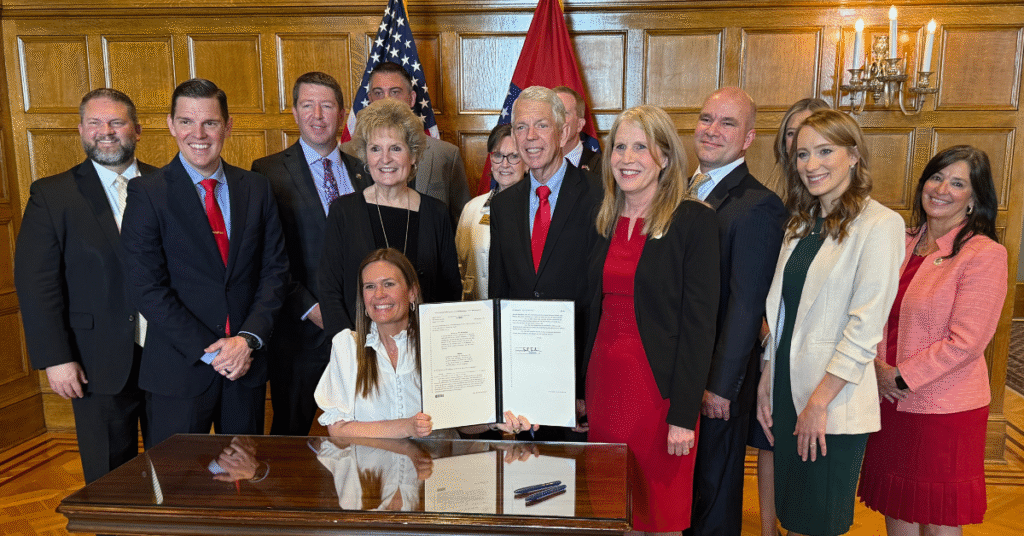
April 8, 2025 – Governor Sarah Huckabee Sanders signs HB 1705

Arkansas Representative Hope Duke authored a strong civics bill requiring the teaching of the Founding Fathers’ religious beliefs and their impact on America’s founding. As a former teacher, Rep. Duke recognized the importance of educating the next generation about the Creator-endowed inalienable rights that form the foundation of our freedoms.

“The purpose of this legislation is for students to learn the intent and meaning behind the documents that created our government. In order for our country to go the right direction, we have to understand the reasoning behind the path our Founding Fathers chose. This bill will ensure students in Arkansas will study how the religious and moral beliefs of the Founding Fathers influenced those decisions. Their intent matters,” said Rep. Duke.

David and Tim Barton testified in support of the bill in the House committee and were honored to stand alongside Rep. Hope Duke as Governor Sarah Huckabee Sanders signed the bill.

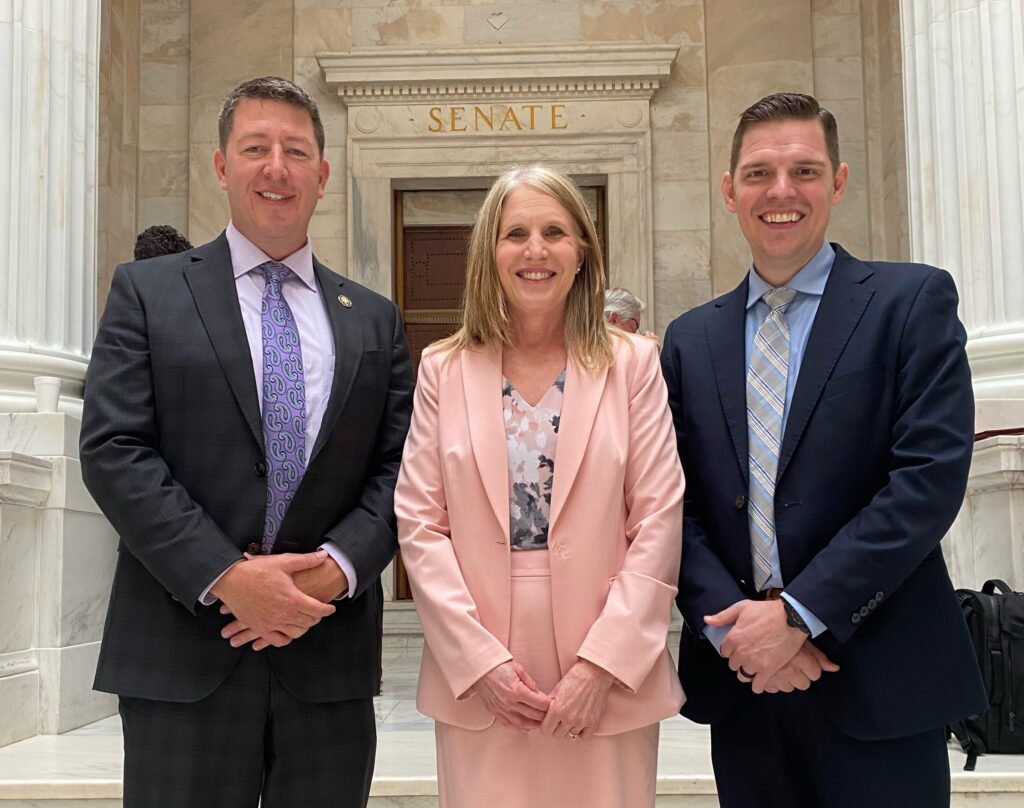
Senate Sponsor: Sen. Joshua Bryant, Rep. Hope Duke, and Tim Barton

The law will ensure students learn:

“How the religious and moral beliefs of the founding fathers influenced the founding of the United States and documents and concepts relevant to the founding fathers’ religious and moral beliefs, including without limitation: 

(A) The identity of the “Creator” as viewed by the founding fathers; 

(B) The nature of mankind, or “human nature”, as viewed by the founding fathers; 

(C) The constitutional requirement for a republican form of government, including the separation of powers and federalism, and the fatal tendency of democracy; 

(D) The religious and moral beliefs held by the founding fathers, whereby there is a Creator, and that man is endowed by that Creator with inalienable rights; 

(E) The definitions of “religion” held by the founding fathers, particularly as found in Section of the Virginia Declaration of Rights; 

 (F) Why there was a demand for a Bill of Rights as a condition for the adoption of the United States Constitution; 

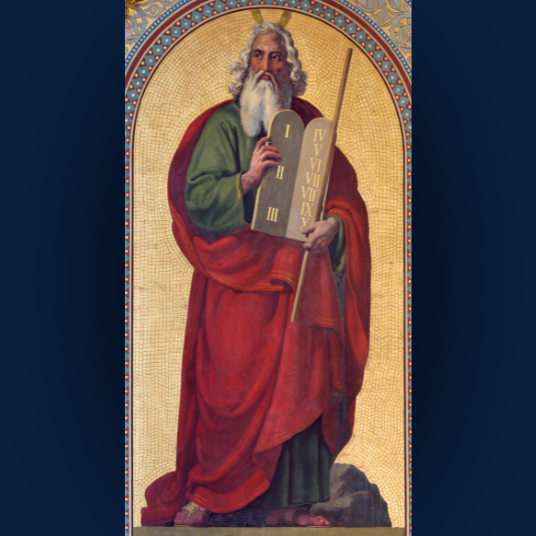
(G) To what extent the founding fathers recognized historical events and texts, such as the Ten Commandments, the Mosaic Law, the New Testament, and the experiences of the ancient Hebrews, Greeks, and Romans, and these teachings as a basis for American law and public policy; 

(H) To what extent the founding fathers recognized the English Common Law, the Magna Carta, and the English Bill of Rights as a basis for American law and public policy; and 

(I) How the recognition of inalienable rights in the Declaration of Independence formed the framework for the abolition of slavery in the United States; and How the freedoms enjoyed by the citizens of the United States can be traced to the beliefs of the founding fathers.”

We hope many more states follow Arkansas’s lead by putting strong requirements in place for civics education.

If you would like assistance on legislation in your state, please let us know. We would love to assist you with resources and testimony support.

Displaying the Ten Commandments in Schools

In recent years, various proposals have emerged across the nation to display copies of the Ten Commandments in public settings, including schools. Many object to such suggestions, believing the Judiciary has determined such displays to be unconstitutional. While this was true over past decades, as a result of recent court decisions, that prohibition no longer exists. With this legal change, a brief overview of the original use of the Decalogue in public settings, its removal during the judicial activism of the 1970s and 1980s, and the new position taken by the Court will be useful.

To read the full brief on the history of the Ten Commandments in America’s public schools, click here.

If you would like assistance with legislation on the topic in your state, please reach out to us at PFLN. We are here to assist you.

Restoring Civics & Government Education: The Failing Social Studies Movement

To preserve America as a federal constitutional republic (the greatest citizen-stewarded self-government on the face of the earth), every citizen must understand both the core principles and the operations of government that sustain us as the longest ongoing constitutional republic in the history of the world. Therefore, every student must be deliberately educated in both government and civics.

At a minimum, a government course must require a thorough study of the content of the US Constitution, the federative republic it establishes, its limited but specifically enumerated powers, and the differing jurisdictions of the varying levels of government. A corresponding civics course must inculcate in each student a thorough understanding of both their rights as well as their duties as a citizen in our federal republic.

Despite these simple thresholds of what should be considered minimal knowledge, current studies repeatedly confirm that students are dismally lacking in these areas of essential knowledge—and have been for the last several years.

To read the full brief on restoring civics by David Barton, click here.

If you would like assistance with legislation on the topic of restoring Civics in your state, please reach out to us at PFLN. We are here to assist you.

Federalism: States Have More Authority than They Think

The U.S. federal government has grown into a leviathan exceeding any of the Founding Fathers’ worst nightmares. Its tentacles have spread into almost every conceivable policy area, which is often in blatant conflict with the powers expressly granted to the federal government by the U.S. Constitution. These areas include but are not limited to education, health care, transportation, firearms, energy, law enforcement, agriculture, housing, and myriad social issues. As the power of the federal government has exponentially grown over the course of the past century in particular, states’ rights have exponentially deteriorated in tandem. If it is not reversed, this phenomenon will eradicate the entire notion of federalism—one of the most important foundations of our constitutional republic. 

Read the full article here, with key takeaways at the end.