Major Victories for Religious Freedom in Texas!

Now is the most opportune time for states to take the lead on religious freedom. For far too long, conservatives have been forced to focus solely on defending religious freedom—but now is the moment not just to defend it, but to advance it. This is a time for lawmakers to think innovatively about areas of society where religion has been excluded for so many decades that people no longer even consider they have the right to express their faith.

We are greatly encouraged to see legislators across the country doing exactly that. They are re-examining state laws to ensure that America’s rich history of Judeo-Christian values is once again incorporated into society and welcomed in the public square, just as the Founding Fathers intended.

This session alone, more than 20 bills have been introduced across the country aimed at restoring the Ten Commandments in public schools. We’ve assisted lawmakers and state education leaders with many bills and policies that welcome the Bible and prayer back into classrooms. Dozens of additional bills have been introduced that address permitting chaplains in schools, allowing religious release time, and—in Arkansas—legislation was passed to ensure the religious beliefs of the Founding Fathers are included in the state’s education standards.

Texas has done an exceptional job addressing nearly all of these religious freedom issues. Last session, they passed legislation allowing chaplains in schools. And as this year’s session nears its close, lawmakers have passed several landmark bills championing religious freedom.

David and Tim Barton were honored to testify in support of two key bills: the Ten Commandments Bill and the Prayer in School Bill—both of which have now passed the House and Senate.
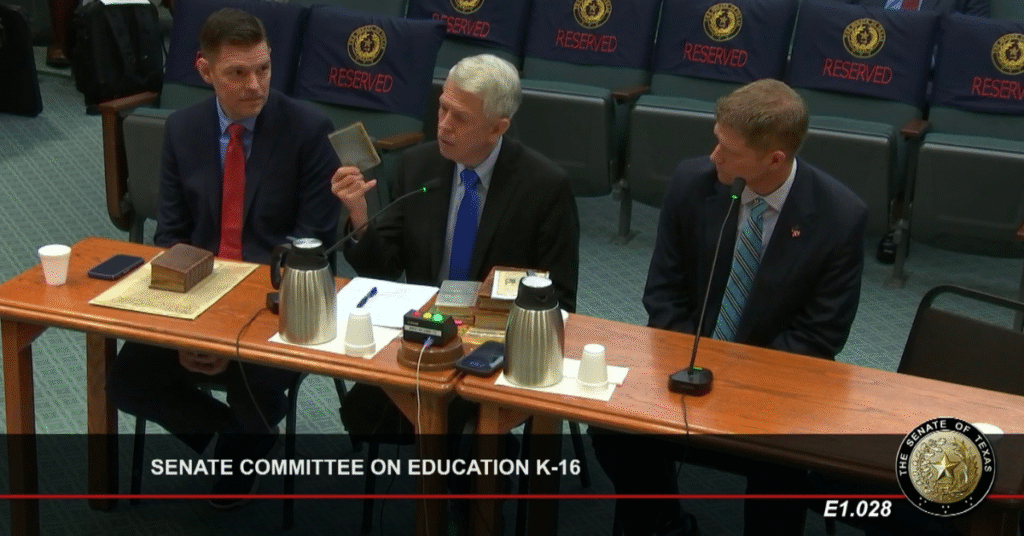
Tim Barton, David Barton & Matt Krause, with First Liberty, Testifying in Senate Committee Hearing

If you would like to donate to our mission at PFLN to help lawmakers advance religious freedom and constitutional policies, we greatly value your support! You can make a tax-deductible donation here. 
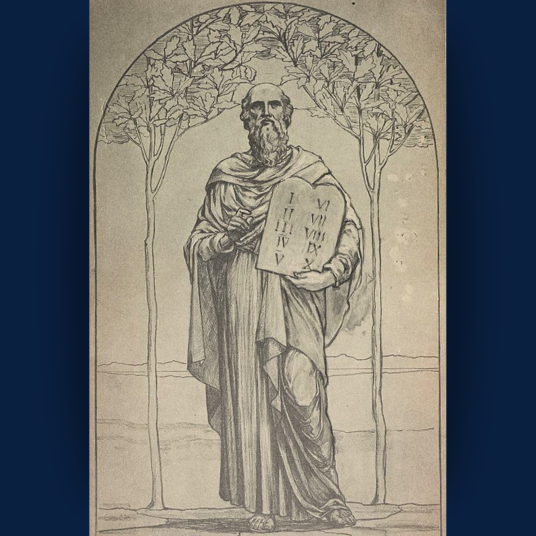
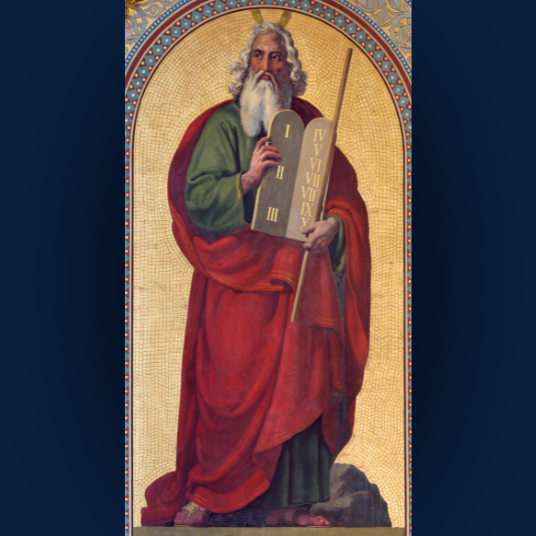
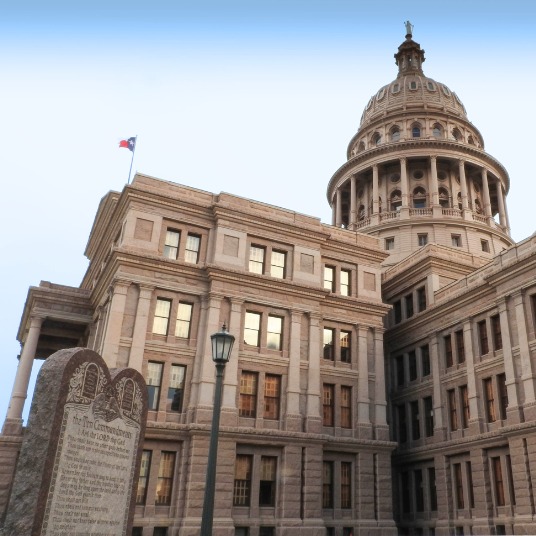
Texas to Display the Ten Commandments in Public School Classrooms

Under this soon to be new law SB 10, the Ten Commandments will be displayed in every public elementary and secondary school classroom across Texas. These timeless principles have long served as a moral compass in American society and were once foundational in public education.

States like Louisiana and Arkansas have passed similar legislation, and we are thrilled to see Texas join them. At our annual conference for state lawmakers, we’ve spent years educating leaders on the historic and legal significance of the Ten Commandments—especially in light of recent shifts in Supreme Court precedent that now make this change possible.

We are deeply grateful for the leadership of Sen. Phil King and Rep. Candy Noble, members of the Pro-Family Legislative Network (PFLN), who sponsored this monumental legislation.

Restoring Prayer and Bible Reading in Public Schools

This legislation, SB 11, permits school districts to adopt policies allowing every campus to offer students and staff the opportunity to participate in a time of prayer and reading from the Bible or other religious texts. We applaud Sen. Mayes Middleton and Rep. David Spiller for their sponsorship of this legislation. 

Religious Release Time – Permitting Parents to Excuse Their Child for A Religious Course, such as a Bible Study

Texas law, with the final passage of SB 1049, will explicitly affirm that parents or guardians may excuse their children during school hours to attend religious courses, such as Bible studies, off-campus. Sen. Phil King led on this bill along with Rep. James Frank. We presented this policy at our annual conference last year and are excited to see Texas pass this bill.

What to Learn More About Why Now is the Time to Advance Religious Freedom? 

First, understand the Lemon Test.
In 1971 in the case Lemon v. Kurtzman the Court announced its new test for determining the permissibility of public religious expressions. It stipulated that for a public religious activity to be constitutional, it must: (1) have a primarily secular purpose, (2) not advance religion, and (3) avoid creating any government entanglement with religion. As you can imagine, this test prohibited nearly all religious displays of religion. The original religious protections of the First Amendment were thus dramatically curtailed.

Over seceding years, the Lemon Test produced increasingly absurd results. The modern Court has now acknowledged that not only was the test flawed but it held an inherent bias against religion.

Second, know the new History and Traditions Test.
Nearly 50 years later, the Supreme Court rejected the Lemon Test in its 2019 ruling in the Bladensburg Cross Case. The Court stated, “retaining established religiously expressive monuments, symbols, and practices….gives rise to a strong presumption of constitutionality.”

In other words, if something religious has been part of the fabric of American society and culture for a long period of time (such as crosses, invocations, Ten Commandments displays, et al.), then they must be presumed to be constitutional. This was a dramatic reversal from the Court’s recent decades of decisions, but a clear return to the Constitution’s original intent.

Three years later in 2022, in the cases Shurtleff v. Boston and Kennedy v. Bremerton, the Court openly rejected the Lemon Test.

This is why the opportunity not just to protect religious freedom, but to advance it, is greater now than at any point in the last 50 years.

If you are a lawmaker who would like assistance with legislation in your state, please don’t hesitate to contact us. We would love to serve you. 

If you would like to donate to our mission at PFLN to help lawmakers advance religious freedom and constitutional policies, we greatly value your support! You can make a tax-deductible donation here. 

Arkansas Becomes 2nd State to Pass Ten Commandments Display in Schools Bill

Senate Sponsor: Sen. Jim Dotson, with Tim Barton and David Barton testifying in support of SB 433

Arkansas has become the second state to require that the Ten Commandments be displayed in every public school classroom (K–12), every public university classroom, and in government buildings.

In the 2024 legislative session, we were honored to assist Louisiana Rep. Dodie Horton with testimony and support, as Louisiana became the first state to return the Ten Commandments to American classrooms. This followed the U.S. Supreme Court’s reversal of the outdated Lemon Test, replacing it with a “history and traditions” standard.

While more than 30 similar bills related to the Ten Commandments were filed during the 2025 legislative session, Arkansas was the first state this year to successfully pass and sign such a bill into law.

There are a few key differences between the Arkansas and Louisiana legislation. Arkansas’s statute falls under the same code section as its “In God We Trust” display requirements for public schools. Additionally, the Arkansas display is far simpler than Louisiana’s—it does not require a disclaimer. The poster will feature only the text of the Ten Commandments. The law also applies not just to public school classrooms but to government buildings as well.

The Arkansas law allows both private and public funds to be used for the displays if necessary. However, during the hearing, bill sponsors clarified that there are no plans to use state funds; they anticipate the displays will be privately funded and donated.

Tim and David Barton, along with Pro-Family Legislative Network Executive Director Audrea Decker, were honored to stand alongside PFLN members Senator Jim Dotson and Representative Alyssa Brown as Governor Sarah Huckabee Sanders signed this historic legislation to restore the Ten Commandments to Arkansas classrooms.

Audrea Decker, House Sponsor Rep. Alyssa Brown, Senate Sponsor Sen. Jim Dotson, Liberty Counsel Senior Litigation Counsel Richard Mast, Sen. Clint Penzo, David and Cheryl Barton, Tim Barton

This law will help ensure students understand the Ten Commandments long-standing importance in America as a foundational part of our history and traditions. 

Understanding the History of Supreme Court Precedent and Religious Displays 

To understand what is happening with this surge of Ten Commandment legislation across the country, it’s important to know the history of the Supreme Court’s standing on this issue. Religious freedom is a bedrock of America’s Founding and the Ten Commandments have long been part of American education. However, in the Supreme Court’s decision in Lemon v. Kurtzman (1971), they set a new criteria called the Lemon test to determine if government actions violated the Establishment Clause of the First Amendment. The test had three main components:

  1. Purpose: The action must have a secular purpose.
  2. Effect: It must not advance or inhibit religion.
  3. Excessive entanglement: It must not excessively involve the government with religion.

For the last several decades expression of America’s religious heritage has been restricted as the Lemon test prohibited many religious displays and dramatically curtailed the original religious freedom protections of the First Amendment.

The Lemon test was the culmination of separationists’ fight to eradicate all references to religion from the public sphere. They used the Lemon test to block as many displays of America’s religious heritage as they could, including Ten Commandments displays and veterans’ memorials. One of the largest upheavals was in Stone v. Graham in 1980. The Supreme Court used the Lemon test to strike down Kentucky’s law requiring that the Ten Commandments be displayed in public schools. This was a turning point in America, as schools across the country removed their Ten Commandment displays.

Supreme Court Overturn of the Lemon Test, Leads with History and Tradition Test

Since the Supreme Court’s implementation of the Lemon test, thousands of cases have been decided by this faulty standard for the past 50 years. However, in recent years the Court reverted back to America’s original interpretation of the First Amendment and in the case Kennedy v. Bremerton School District. The Court overturned Lemon and instead looked to America’s history and tradition for whether the government may recognize our religious heritage.

Expanding Religious Freedom in Public Life

America can once again welcome religious displays back into the public square if they are part of our nation’s long-standing history and traditions. Nativity scenes, the Ten Commandments in classrooms and courtrooms, can all be reintegrated into American society. The time is ripe for moral and religious support to be encouraged in schools and in the public square.

Considering Ten Commandment Legislation in Your State? We are ready to help! 

We continue to work with legislators across the country on this issue through our Pro-Family Legislative Network. If you would like assistance with similar legislation in your state, please let us know.

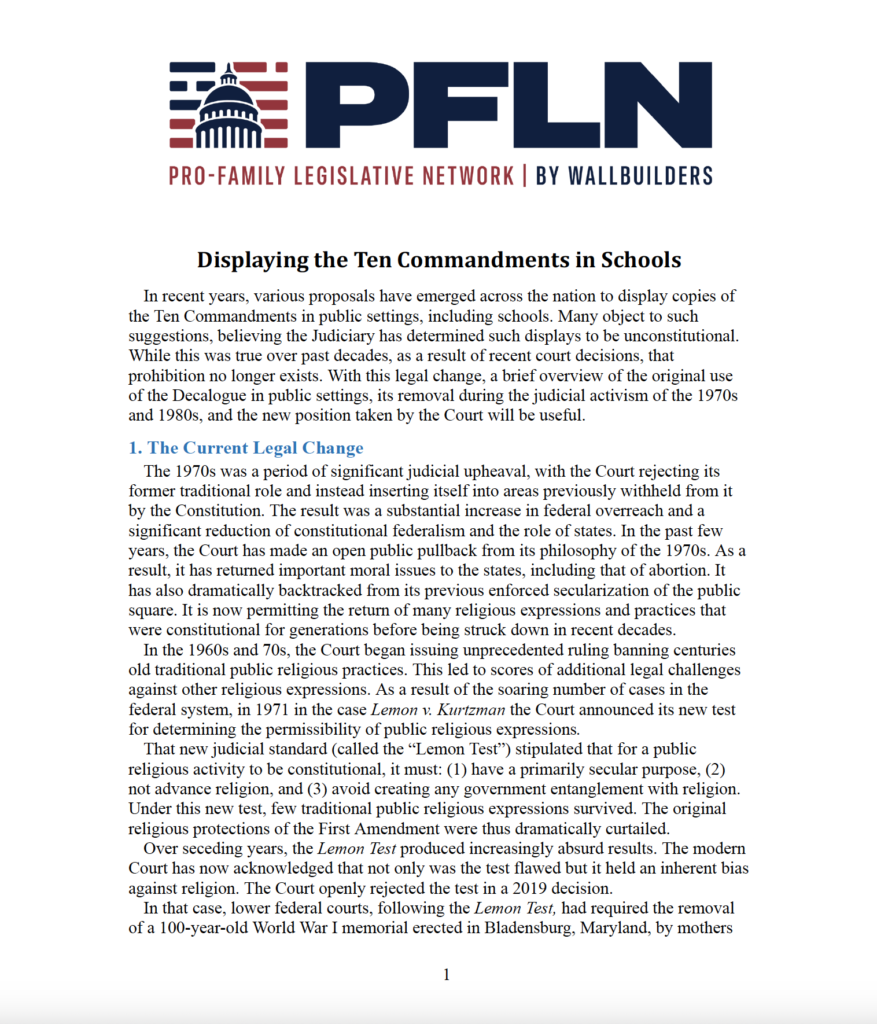
Displaying the Ten Commandments in Schools

In recent years, various proposals have emerged across the nation to display copies of the Ten Commandments in public settings, including schools. Many object to such suggestions, believing the Judiciary has determined such displays to be unconstitutional. While this was true over past decades, as a result of recent court decisions, that prohibition no longer exists. With this legal change, a brief overview of the original use of the Decalogue in public settings, its removal during the judicial activism of the 1970s and 1980s, and the new position taken by the Court will be useful.

To read the full brief on the history of the Ten Commandments in America’s public schools, click here.

If you would like assistance with legislation on the topic in your state, please reach out to us at PFLN. We are here to assist you.

Displaying the 10 Commandments in Louisiana Public Schools

​​The law given from [Mount] Sinai was a civil and municipal as well as a moral and religious code; it contained many statutes…of universal application—laws essential to the existence of men in society, and most of which have been enacted by every nation which ever professed any code of laws….Vain, indeed, would be the search among the writings of profane antiquity…to find so broad, so complete and so solid a basis for morality as this Decalogue [the Ten Commandments] lays down.[1] President John Quincy Adams

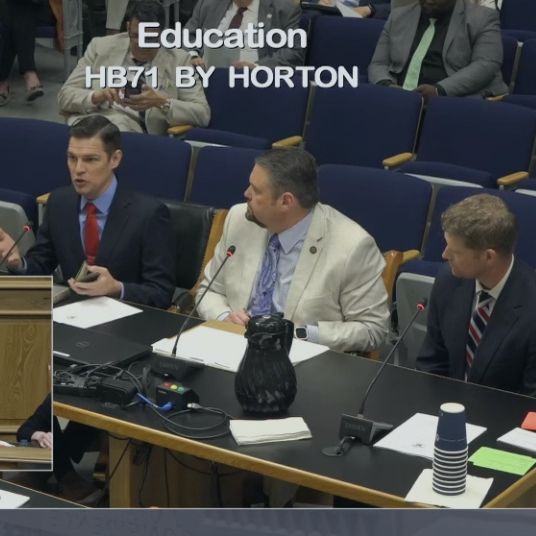
We celebrate the passage and signing of Louisiana’s HB 71, sponsored by Representative Dodie Horton and Senator Adam Bass. The bill allows the Ten Commandments to be displayed in public school classrooms.

Louisiana is the first state in the nation to pass this historic legislation since the Supreme Court rejected the “Lemon Test” and instituted the new “History and Traditions Test.”

What is the Lemon Test?
In 1971 in the case Lemon v. Kurtzman the Court announced its new test for determining the permissibility of public religious expressions. It stipulated that for a public religious activity to be constitutional, it must: (1) have a primarily secular purpose, (2) not advance religion, and (3) avoid creating any government entanglement with religion. As you can imagine, this test prohibited nearly all religious displays of religion. The original religious protections of the First Amendment were thus dramatically curtailed.

Over seceding years, the Lemon Test produced increasingly absurd results. The modern Court has now acknowledged that not only was the test flawed but it held an inherent bias against religion.

The New History and Traditions Test
Nearly 50 years later, the Supreme Court rejected the Lemon Test in its 2019 ruling in the Bladensburg Cross Case. The Court stated, “retaining established religiously expressive monuments, symbols, and practices….gives rise to a strong presumption of constitutionality.”[2]

In other words, if something religious has been part of the fabric of American society and culture for a long period of time (such as crosses, invocations, Ten Commandments displays, et al.), then they must be presumed to be constitutional. This was a dramatic reversal from the Court’s recent decades of decisions, but a clear return to the Constitution’s original intent.

Three years later in 2022, in the cases Shurtleff v. Boston[3] and Kennedy v. Bremerton,[4] the Court openly rejected the Lemon Test.

With the Court’s renouncement of the Lemon Test, the Ten Commandments may once again be permitted in schools as they once were based on the fact that it is part of America’s history, traditions, and the foundation of our law in America.

As President Dwight Eisenhower said so well:

“The blessings of life and the freedoms all of us enjoy in this land today are based in no small measure on the Ten Commandments, which have been handed down to us by the religious teachers of the Jewish faith. These Commandments of God provide endless opportunities for fruitful service, and they are a stronghold of moral purpose for men everywhere.” [5]

If you would like assistance with similar legislation in your state, please reach out to us at PFLN. We are here to assist you.


Sources:

  1. John Quincy Adams, Letters of John Quincy Adams, to His Son, on the Bible and Its Teachings (Auburn: James M. Alden, 1850), 61, 70-71.
  2. American Legion v. American Humanist Association, 588 U.S. __, 2085 (2019).
  3. Shurtleff v. City of Boston, 596 U.S. ___ (2022).
  4. Kennedy v. Bremerton School District, 597 U.S. ___ (2022).
  5. Dwight D. Eisenhower, “Statement by the President on the Occasion of the Jewish High Holy Days,” September 26, 1957, Public Papers of the Presidents of the United States: Dwight D. Eisenhower 1957 (Washington DC: United States Government Printing Office, 1958), 695.