The law given from [Mount] Sinai was a civil and municipal as well as a moral and religious code; it contained many statutes…of universal application—laws essential to the existence of men in society, and most of which have been enacted by every nation which ever professed any code of laws….Vain, indeed, would be the search among the writings of profane antiquity…to find so broad, so complete and so solid a basis for morality as this Decalogue [the Ten Commandments] lays down.[1] President John Quincy Adams
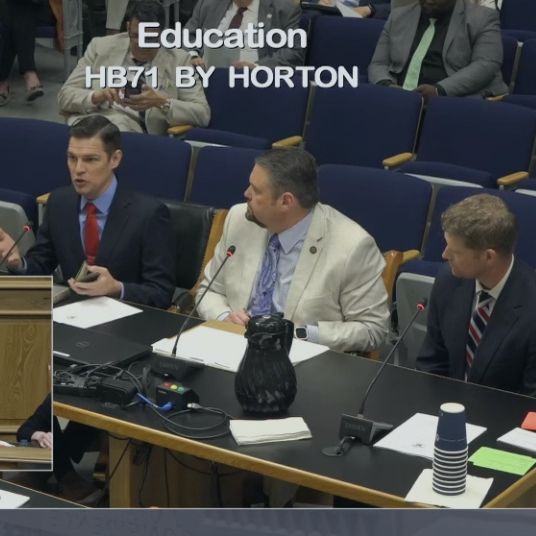
We celebrate the passage and signing of Louisiana’s HB 71, sponsored by Representative Dodie Horton and Senator Adam Bass. The bill allows the Ten Commandments to be displayed in public school classrooms.
Louisiana is the first state in the nation to pass this historic legislation since the Supreme Court rejected the “Lemon Test” and instituted the new “History and Traditions Test.”
What is the Lemon Test?
In 1971 in the case Lemon v. Kurtzman the Court announced its new test for determining the permissibility of public religious expressions. It stipulated that for a public religious activity to be constitutional, it must: (1) have a primarily secular purpose, (2) not advance religion, and (3) avoid creating any government entanglement with religion. As you can imagine, this test prohibited nearly all religious displays of religion. The original religious protections of the First Amendment were thus dramatically curtailed.
Over seceding years, the Lemon Test produced increasingly absurd results. The modern Court has now acknowledged that not only was the test flawed but it held an inherent bias against religion.
The New History and Traditions Test
Nearly 50 years later, the Supreme Court rejected the Lemon Test in its 2019 ruling in the Bladensburg Cross Case. The Court stated, “retaining established religiously expressive monuments, symbols, and practices….gives rise to a strong presumption of constitutionality.”[2]
In other words, if something religious has been part of the fabric of American society and culture for a long period of time (such as crosses, invocations, Ten Commandments displays, et al.), then they must be presumed to be constitutional. This was a dramatic reversal from the Court’s recent decades of decisions, but a clear return to the Constitution’s original intent.
Three years later in 2022, in the cases Shurtleff v. Boston[3] and Kennedy v. Bremerton,[4] the Court openly rejected the Lemon Test.
With the Court’s renouncement of the Lemon Test, the Ten Commandments may once again be permitted in schools as they once were based on the fact that it is part of America’s history, traditions, and the foundation of our law in America.
As President Dwight Eisenhower said so well:
“The blessings of life and the freedoms all of us enjoy in this land today are based in no small measure on the Ten Commandments, which have been handed down to us by the religious teachers of the Jewish faith. These Commandments of God provide endless opportunities for fruitful service, and they are a stronghold of moral purpose for men everywhere.” [5]
If you would like assistance with similar legislation in your state, please reach out to us at PFLN. We are here to assist you.
Sources:
- John Quincy Adams, Letters of John Quincy Adams, to His Son, on the Bible and Its Teachings (Auburn: James M. Alden, 1850), 61, 70-71.
- American Legion v. American Humanist Association, 588 U.S. __, 2085 (2019).
- Shurtleff v. City of Boston, 596 U.S. ___ (2022).
- Kennedy v. Bremerton School District, 597 U.S. ___ (2022).
- Dwight D. Eisenhower, “Statement by the President on the Occasion of the Jewish High Holy Days,” September 26, 1957, Public Papers of the Presidents of the United States: Dwight D. Eisenhower 1957 (Washington DC: United States Government Printing Office, 1958), 695.